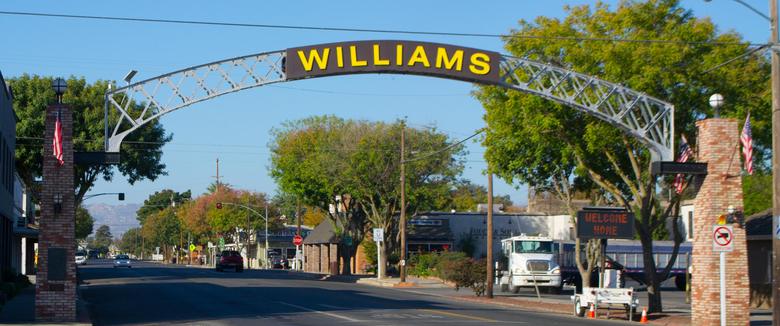

Williams, California
Williams Civic Watch
Your city government, in plain sight
Meetings, decisions, fees and your rights in Williams, with a source for every fact.
Next City Council meeting
6:00 PM · Council Chambers, 810 E Street
Calculated date · Agenda not posted yet (checked Nov 9, 2026).
Confirm the date with the City Clerk: (530) 235-3274Official agendas
The Constitution Course
Your rights under the US and California constitutions, and how they apply at City Hall. 68 short lessons. Your progress stays in this browser.
Start: the essentials, 5 lessons See all lessons The essentials: 5 lessons
Start here
Get it done
Business license, permits, water, records and city phone numbers.
What the council just did
The October 21 meeting: votes, money and contracts.
Report a problem
File a complaint about weeds, potholes, water, sewer or police. Who to call and what to say.
Know your rights
Recording meetings, getting records, water shut-offs, fines, taxes and more, with the lesson behind each.
Where Williams fits
The three layers of law
City rules sit under state law, and state law sits under federal law.
U.S. Constitution and Bill of Rights; federal laws
When they clash, the higher layer usually wins.
What the council decided
Meeting of
Unofficial results from the meeting video, until the minutes are approved
16 Automatic yearly fee increases, cost to residents not stated
Approved 5-0 Fees/rates
18 City Manager raise, car allowance, five-year term, severance up to six months
Approved 4-1 Staff pay/benefits
15 $1.47M contract, plus $122,936 not in the title and a General Fund cash backstop up to $800,000
Approved unanimous Money
1 Recology garbage rate increase letter
No vote Fees/rates
Sources: Verified7
Know your rights
Ten questions about your rights with city government. Open one for the full answer: the text of the law, the steps and deadlines, the court cases, what applies in Williams, what to do if the rules are not followed, and common misconceptions, with a source for each point.
Can the city raise my water rate?
What the Constitution says
Yes, but only by following Article XIII D, section 6 of the California Constitution, added by Proposition 218 in 1996. Water, sewer and trash charges are "property-related" fees, and the section says an agency "shall follow the procedures pursuant to this section in imposing or increasing any fee or charge" (Art. XIII D, §6(a)). The California Supreme Court treats ongoing water delivery charges as property-related fees; one-time charges for a new connection are not (Bighorn-Desert View Water Agency v. Verjil, 2006).
Before a new or higher rate, the city must identify every affected parcel, calculate the amount for each, and mail written notice "to the record owner of each identified parcel" giving "the amount of the fee or charge proposed," "the basis upon which the amount ... was calculated," "the reason for the fee or charge," and "the date, time, and location of a public hearing" (§6(a)(1)).
The hearing must be held "not less than 45 days after mailing the notice." At the hearing the city "shall consider all protests," and "if written protests against the proposed fee or charge are presented by a majority of owners of the identified parcels, the agency shall not impose the fee or charge" (§6(a)(2)).
How a protest works, step by step
- The notice. For an existing service, state law lets the city put the notice in your regular bill or mail it to the billing address; if the city wants to keep its power to put a lien on the parcel, it must also mail the record owner at the assessment-roll address when that is different (Gov. Code §53755(a)).
- Who can protest. "One written protest per parcel, filed by an owner or tenant of the parcel, shall be counted" (§53755(b)). Renters can file the protest for their parcel, but each parcel counts once.
- What counts. Only written protests count toward the majority (Art. XIII D, §6(a)(2)). Speaking at the hearing is allowed (Gov. Code §54954.3), but a spoken objection is not a written protest.
- The count. The majority is measured against the number of identified parcels, not the number of people who show up (§6(a)(2)). The city must keep every written protest for at least two years after the hearing (§53755(d)), so the protests and the count can be requested under the Public Records Act during that time.
- The deadline. Protests must be "presented" at the hearing (§6(a)(2)). Ask the City Clerk, 810 E Street, (530) 235-3274, how and by when the city accepts them for a given hearing.
The limits on any water rate, even without a protest
Winning or losing a protest doesn't end the rules. Every existing, new or higher property-related fee must meet five tests (Art. XIII D, §6(b)):
- Revenue "shall not exceed the funds required to provide the property-related service" (§6(b)(1)).
- Revenue "shall not be used for any purpose other than that for which the fee or charge was imposed" (§6(b)(2)).
- The charge on a parcel "shall not exceed the proportional cost of the service attributable to the parcel" (§6(b)(3)).
- No charge for a service unless it is "actually used by, or immediately available to, the owner"; charges "based on potential or future use of a service are not permitted" (§6(b)(4)).
- No property-related fee for "general governmental services" such as police, fire, ambulance or library services that are available to the public at large (§6(b)(5)).
In a lawsuit, "the burden shall be on the agency to demonstrate compliance with this article" (§6(b)). Water, sewer and trash are exempt from the separate vote that other property-related fees need, but not from the notice, hearing and protest (§6(c)).
Sources: Verified8
Rate schedules over several years
A water, sewer or trash agency may adopt a schedule of rates for up to five years that includes automatic inflation adjustments or pass-through increases from a wholesale supplier, if the schedule was adopted through the Prop. 218 process, any inflation adjustment doesn't exceed the cost of service, and notice of each adjustment is given at least 30 days before it takes effect (Gov. Code §53756).
This is why one hearing can set increases that arrive year after year: the protest happens once, when the schedule is adopted.
Sources: Verified13
In Williams
- The 2026 increase. The rate hearing opened Nov 19, 2025 and was continued to Jan 21, 2026, when the council adopted Resolution 26-01, 5-0. July 2025 minutes say the previous increase under Prop. 218 was in 2016.
- What it means for a bill. For a typical home with a small meter, fixed water and sewer charges go from $117.37 a month (Dec 2024) to $133.60 (Feb 2026) and $184.68 (Feb 2030). The increases are scheduled each February 1 from 2026 to 2030, and your bill also depends on meter size and water use. Full tables: Williams water and sewer rates.
- Notice of each step. The city says the council adopted "a series of water rate adjustments for the years 2026 to 2030" on Jan 21, 2026. A schedule adopted under §53756 requires notice of each adjustment at least 30 days before it takes effect. To ask what notice the city sends before each February increase, call the City Clerk, (530) 235-3274.
- Trash. On Oct 21, 2026 the council received a letter from Recology about its annual rate increase. Refuse collection is one of the three services named in §6(c). Recology's letter requests the increase "per the Franchise Agreement" using a formula with three parts (base rate up 3.8%, fuel up 38.4%, disposal up 1%). For homes that comes to 3.93%, or $1.64 more a month for a 96-gallon cart, starting Jan 1, 2027. The city posts its contract with Recology on its Public Notices page. To ask what notice goes with these increases, call the City Clerk, (530) 235-3274.
- Not every fee is a water rate. On Oct 21, 2026 the agenda also listed Resolution 26-40, raising business license and building fees each year by CPI. Those aren't property-related fees, so the Prop. 218 protest doesn't apply. Instead the city must show such a charge "is not a tax" and is "no more than necessary to cover the reasonable costs" (Art. XIII C, §1(e)).
- Who to ask. Finance and water payments: 464 8th Street, Finance Director (530) 235-3271. City Clerk (protests and records): 810 E Street, (530) 235-3274.
If the city doesn't follow the rules
- Object in writing before the hearing. Since 2025, if the city follows a set of steps (posting the written basis for the fee online, giving at least 45 days to object, and answering each objection in writing before the hearing), a lawsuit claiming the water or sewer fee violates Article XIII D is barred unless the person "timely submitted to the local agency a written objection ... that specifies the grounds" (Gov. Code §53759.1(b)-(c)). The notice must say so in a "prominently displayed statement" (§53759.1(c)(6)). Read the notice for that statement.
- Sue within 120 days. A court challenge to a water or sewer rate adopted or changed after Jan 1, 2022 must be filed within 120 days of the effective date or final adoption, whichever is later, and the mailed notice must state that limit (Gov. Code §53759(a), (d), (f)). Billing errors are not covered by that limit (§53759(e)).
- Reduce the rate by initiative. The Constitution says the initiative power "shall not be prohibited or otherwise limited in matters of reducing or repealing any local tax, assessment, fee or charge" (Art. XIII C, §3). The Supreme Court held this "expressly authorizes initiative measures ... insofar as they seek to reduce or repeal a public agency's water rates," but not measures requiring a vote on future increases (Bighorn). See Initiative and referendum.
Common misconceptions
- "The council can raise water rates by a simple vote." Not without the mailed notice, the 45-day wait and the protest hearing (Art. XIII D, §6(a)).
- "Water rate increases go on the ballot." Not automatically. Water, sewer and trash are exempt from the property-owner or voter election (§6(c)); residents can still propose a reduction by initiative (Art. XIII C, §3).
- "Only owners can protest." The Constitution's notice goes to owners, but state law counts one protest per parcel from "an owner or tenant" (Gov. Code §53755(b)).
- "Water money can fill other budget holes." Revenue can't be used for any other purpose (§6(b)(2)).
The lessons and guides
Can I record a council meeting?
What the law says
Yes. "Any person attending an open and public meeting of a legislative body of a local agency shall have the right to record the proceedings in the absence of a reasonable finding by the legislative body of the local agency that the recording cannot continue without noise, illumination, or obstruction of view that constitutes, or would constitute, a persistent disruption of the proceedings" (Gov. Code §54953.5(a)).
Since Jan 1, 2026 the section says "record the proceedings" without listing particular devices, so it covers a phone as much as a camera. A separate section protects broadcasting: the council can't "prohibit or otherwise restrict the broadcast of its open and public meetings" without the same kind of finding about noise, light or blocked view (Gov. Code §54953.6). That covers livestreaming a meeting yourself.
The right comes from the California Constitution: "the meetings of public bodies and the writings of public officials and agencies shall be open to public scrutiny," and laws that further that access "shall be broadly construed" (Art. I, §3(b)(1)-(2)).
How it works in the room
- No permission needed. The right belongs to "any person attending"; there's no requirement to ask first or announce yourself (§54953.5(a)).
- No sign-in needed. You can't be required "to register his or her name, to provide other information, to complete a questionnaire" as a condition of attending. Any sign-in sheet must say it is voluntary (Gov. Code §54953.3).
- The only limit is disruption. The council can stop a recording only by making "a reasonable finding" that the recording itself causes noise, light or a blocked view amounting to "a persistent disruption" (§54953.5(a)). Quiet recording from a seat or the back of the room doesn't meet that test on its face. A bright light or a tripod in the aisle could.
- What can't be recorded. Closed sessions are not open meetings, so the public isn't in the room (Gov. Code §54962). See "Can the council meet in private?" below.
- Disrupting the meeting is a separate matter. If a meeting is "willfully interrupted" so that order can't be restored by removing the people responsible, the council may clear the room and continue, but press not involved in the disturbance may stay (Gov. Code §54957.9). Willfully disturbing a lawful meeting is a misdemeanor (Penal Code §403). Recording isn't disturbing.
The city's own recordings
Any recording the city makes of an open meeting "shall be subject to inspection pursuant to the California Public Records Act," but "may be erased or destroyed 30 days after the recording." Inspection of an audio or video recording "shall be provided without charge on equipment made available by the local agency" (§54953.5(b)).
Williams streams and archives its meetings on AV Capture All, and the agenda calls the livestream "a courtesy". The law lets a city erase its recordings after 30 days (§54953.5(b)), so a copy you make yourself is the only one you control. If a past video matters, download it or request a copy from the City Clerk, (530) 235-3274, soon after the meeting.
If you're told to stop
- At the meeting. Ask, calmly and on the record, whether the council is making the finding §54953.5(a) requires: that your recording causes noise, light or a blocked view that is a persistent disruption. Keep the exchange short; the video itself will show what happened.
- Afterwards: cease and desist. To challenge a past violation, state law requires a letter first. Send it by postal mail or fax to the City Clerk within nine months, clearly describing the action and the violation. The council has 30 days to respond. If it doesn't give an "unconditional commitment" to stop, you have 60 days to sue (Gov. Code §54960.2(a)-(b)).
- Going to court. "Any interested person" can sue "for the purpose of stopping or preventing violations or threatened violations" (Gov. Code §54960(a)). A court may award costs and "reasonable attorney fees" to a plaintiff who proves a violation (Gov. Code §54960.5).
- What doesn't apply. The cure-and-correct demand (§54960.1) lets you void an action taken in violation of §§54953, 54954.2, 54954.5, 54954.6, 54956 or 54956.5. The recording section (§54953.5) isn't on that list, so being stopped from recording doesn't by itself void the council's votes that night.
Common misconceptions
- "You need the mayor's permission." The statute gives the right to the person attending; the only exception is a reasonable finding of persistent disruption (§54953.5(a)).
- "The city's livestream means you don't need to record." The city may erase its recordings after 30 days (§54953.5(b)), and Williams calls its stream a courtesy.
- "Speakers can refuse to be recorded." The right is to record "the proceedings," and public comment is part of them (§54953.5(a)). The statute has no opt-out for speakers.
- "Cities can set stricter rules." A city can give more access than the Brown Act requires, not less (Gov. Code §54953.7).
The lessons and guides
Can I speak about anything at a meeting?
What the law says
About anything within the council's "subject matter jurisdiction," which in practice means anything the city can act on. "Every agenda for regular meetings shall provide an opportunity for members of the public to directly address the legislative body on any item of interest to the public, before or during the legislative body's consideration of the item, that is within the subject matter jurisdiction of the legislative body" (Gov. Code §54954.3(a)(1)).
Two rules protect what you say. "The legislative body of a local agency shall not prohibit public criticism of the policies, procedures, programs, or services of the agency, or of the acts or omissions of the legislative body" (§54954.3(c)). And the California Constitution gives the people "the right to instruct their representatives, petition government for redress of grievances, and assemble freely to consult for the common good" (Art. I, §3(a)). The U.S. Supreme Court has called the right to petition "one of the most precious of the liberties safeguarded by the Bill of Rights" (Lozman).
The protection has an edge: §54954.3(c) doesn't "confer any privilege or protection for expression beyond that otherwise provided by law". Speech that is unprotected elsewhere, such as true threats, stays unprotected at the podium.
How public comment works
- Agenda items. You can speak on an item "before or during" the council's consideration of it (§54954.3(a)(1)).
- Topics not on the agenda. You can raise them in general public comment, but "no action or discussion shall be undertaken on any item not appearing on the posted agenda." Council members or staff may "briefly respond," ask clarifying questions, refer the matter to staff, ask staff to report back, or "take action to direct staff to place a matter of business on a future agenda" (Gov. Code §54954.2(a)(3)). The last one is how a comment turns into a future vote.
- Special meetings. You can speak only on items described in the meeting notice (§54954.3(a)(3)), because no other business may be considered at a special meeting (Gov. Code §54956(a)).
- Time limits. The council may adopt "reasonable regulations," including limits on "the total amount of time allocated for public testimony on particular issues and for each individual speaker" (§54954.3(b)(1)).
- Interpreters. If the council limits time, a speaker who uses a translator gets "at least twice the allotted time," unless the council uses simultaneous translation equipment (§54954.3(b)(2)-(3)).
- Your name. Attendance can't be conditioned on giving your name (Gov. Code §54953.3).
In Williams
- When. Regular meetings are the third Wednesday of each month at 6:00 PM, Council Chambers, City Hall, 810 E Street. General public comment is item D, near the start.
- What the agenda says. "This is an opportunity for the public to speak to the Council on any item other than those listed for public hearing on this Agenda. Speakers are requested to use the podium ... and to begin by stating their name, whether they reside in Williams and the name of the organization they represent if any. The mayor may impose a time limit on any speaker depending on the number of people wanting to speak and time available for the rest of the agenda. In the event comments are related to an item scheduled on the agenda, speakers should wait to make their comments until that item is considered" (Oct 21, 2026 agenda). Note "requested": the agenda asks for your name and residence rather than requiring them. State law bars requiring your name as a condition of attending (§54953.3).
- Spanish. The Oct 21, 2026 packet includes a Spanish agenda.
- Rules of procedure. Meeting procedures are set by council resolution (Williams Municipal Code §2.04.020, third-party copy). To get the current rules, including any time limit per speaker, ask the City Clerk, (530) 235-3274.
- Remote and written comment. We didn't find a way to comment remotely in the Oct 21, 2026 agenda. Ask the City Clerk, (530) 235-3274, whether written comments are accepted and read or filed. Bringing a written copy of your comment for the clerk puts it in the record.
If you're cut off or silenced
- Viewpoint matters. A time limit applied evenly is allowed (§54954.3(b)(1)); stopping a speaker because they criticize the city or the council is what §54954.3(c) forbids.
- Cease and desist, then court. Send a letter to the City Clerk by mail or fax within nine months describing what happened; the council has 30 days to respond with an unconditional commitment, and you have 60 days after that to sue (Gov. Code §54960.2). Any interested person can sue to stop or prevent violations (§54960(a)), and a winning plaintiff may recover attorney fees (§54960.5).
- What doesn't apply. §54954.3 isn't on the list of sections whose violation can void a council action through a cure-and-correct demand (§54960.1(a)). If the problem is that the council acted on something not on the posted agenda, that is §54954.2, which is on the list: send the written demand within 30 days of the action (§54960.1(c)(1)).
Common misconceptions
- "The council has to answer my question." It may briefly respond, but the law doesn't require an answer, and it bars discussion of items not on the agenda (§54954.2(a)(3)).
- "I can only talk about agenda items." General public comment covers anything within the council's jurisdiction (§54954.3(a)(1)).
- "Criticizing a council member by name is out of order." Criticism of "the acts or omissions of the legislative body" can't be prohibited (§54954.3(c)).
- "My comment will get a vote tonight." Not if it isn't on the agenda; ask the council to direct staff to place it on a future agenda (§54954.2(a)(3)).
The lessons and guides
Can a city inspector come into my home?
What the Constitution says
Not without your consent or an inspection warrant signed by a judge, except in an emergency. In Camara v. Municipal Court (1967), the U.S. Supreme Court held that housing-code inspections are searches under the Fourth Amendment: "except in certain carefully defined classes of cases, a search of private property without proper consent is 'unreasonable' unless it has been authorized by a valid search warrant." The tenant there "had a constitutional right to insist that the inspectors obtain a warrant to search" and "may not constitutionally be convicted for refusing to consent to the inspection".
The same day, See v. City of Seattle extended this to businesses: "administrative entry, without consent, upon the portions of commercial premises which are not open to the public may only be compelled through prosecution or physical force within the framework of a warrant procedure".
California courts apply it to nuisance abatement: "In the absence of consent or exigent circumstances, government officials engaged in the abatement of a public nuisance must have a warrant to enter any private property where such entry would invade a constitutionally protected privacy interest" (Gleaves v. Waters, 1985). The court limited this to entries that "infringe upon constitutionally recognized expectations of privacy".
How an inspection warrant works
California's inspection-warrant law is Code of Civil Procedure §§1822.50 to 1822.59:
- What it is. "An order, in writing, in the name of the people, signed by a judge of a court of record," for an inspection "relating to building, fire, safety, plumbing, electrical, health, labor, or zoning" (§1822.50).
- The application. It must be supported by an affidavit "particularly describing" the place and the purpose, and must state "that consent to inspect has been sought and refused" or give facts justifying not asking (§1822.51). The judge may question the applicant under oath and must be satisfied the grounds exist (§1822.53).
- The standard. Cause exists if "reasonable legislative or administrative standards for conducting a routine or area inspection are satisfied" for the property, or "there is reason to believe that a condition of nonconformity exists" there (§1822.52). This is lower than criminal probable cause: Camara said a warrant may rest on area-wide inspection standards, which "may be based upon the passage of time, the nature of the building ... or the condition of the entire area".
- Limits on the warrant. It must describe each place to be inspected and "the purpose and limitations of the inspection" (§1822.54). It lasts no more than 14 days unless the judge extends it, and is void if not carried out in time (§1822.55).
- How it is carried out. No inspection between 6:00 p.m. and 8:00 a.m., and not when no owner or occupant is present, unless the judge specifically allows it. No forcible entry unless the judge expressly authorizes it for a suspected immediate threat to health or safety or after earlier attempts to serve a warrant failed. Where you refused consent, you must get notice "at least 24 hours before the warrant is executed," unless the judge finds immediate execution necessary (§1822.56).
- Refusing a warrant. Once there is a warrant, willfully refusing to permit the inspection is a misdemeanor (§1822.57). The right is to insist on a warrant, not to block one.
Exceptions
- Emergencies. The warrant rule doesn't "foreclose prompt inspections, even without a warrant, that the law has traditionally upheld in emergency situations" (Camara).
- Consent. If you or another person with authority let the inspector in, there is no warrant question (Camara: a search "without proper consent" needs a warrant).
- Areas without a privacy interest. Gleaves applies the warrant rule only where entry would invade a constitutionally protected privacy interest, and See covers only the parts of a business "not open to the public".
In Williams: what the city code says
- Nuisance abatement. If the owner doesn't give written consent, the city enters with verbal permission, an inspection warrant or another lawful way (Williams Municipal Code §8.16.120(F)).
- Garbage. The refuse chapter allows entry "after obtaining either a warrant or permission to do so from the owner or occupant of the premises" (§8.08.090).
- Water and sewer. The water chapter gives a "right of entering any or all premises for the purpose of determining whether the provisions of this chapter are being complied with" (§13.04.310), and the sewer chapter says staff "shall be permitted to enter all properties from which wastes or wastewaters are being or are capable of being discharged into the sewage system" (§13.08.060). Neither mentions a warrant or consent.
- Refusing entry and water service. "If any water user refuses entry by, or hinders or prevents inspection by the director or his representative, then the city may discontinue water service to the premises until and unless entry is allowed" (§13.04.220(E)). Camara involved a criminal penalty for refusing; whether a utility shut-off is treated the same way is a question we know of no court answering for Williams. See the Williams entry lesson.
- Code text. These quotes come from a third-party copy of the code (GoCodebook); the official code is on Municode. Check a quote there or with the City Clerk before relying on it.
In Williams: what happens after an inspection
An inspection often leads to one of two papers, each with its own deadline:
- Notice to abate. It orders you to fix a nuisance by a compliance date and is posted on the property and delivered in person or by certified mail (§8.16.110(B)). To contest it, file a written hearing request with the City Clerk within 15 days (§8.16.110(A)). If you don't, the nuisance is treated as confirmed (§8.16.110(E)). The hearing is within 45 days of your request, the city must prove the nuisance by a preponderance of the evidence, and the written decision is due within 10 days (§§8.16.110(D), 8.16.120(C), 8.16.130). If the city fixes the problem itself, the cost can become a lien or special assessment (§8.16.140).
- Administrative citation. A fine with a correction date. Ask for a hearing within 21 days of the citation, with the fine as a deposit or an approved waiver; a waiver request goes to the finance officer within 10 days (§§8.16.510, 8.16.520). The hearing officer can't be someone who investigated or enforced the case (§8.16.475(C)), and you can question the officer, present evidence and bring a lawyer (§8.16.530). Not showing up forfeits the fine and your right to go to court (§8.16.570(A)).
- Court. After a citation hearing, you can appeal to the Colusa County Superior Court within 20 days after the decision is served; the court hears the case fresh (Gov. Code §53069.4(b)(1)). The court has two locations, both in Colusa: the Main Courthouse, 547 Market St., and the Courthouse Annex, 532 Oak St. Call (530) 458-5149 to ask where to file.
- Contacts. Code Enforcement, 700 North Street, (530) 473-2533. Building, 460 8th Street, (530) 235-3276. City Clerk, 810 E Street, (530) 235-3274.
At the door
- You can ask the inspector's name, department and purpose, and whether they have a warrant. A warrant must describe the place and "the purpose and limitations of the inspection" (§1822.54).
- Without a warrant and outside an emergency, you can decline entry (Camara). Saying no is what the warrant application has to report: "consent to inspect has been sought and refused" (§1822.51), and it entitles you to 24 hours' notice before a warrant is executed unless a judge finds otherwise (§1822.56).
- If they have a warrant, read its limits and don't obstruct it (§1822.57). Note the time, the names and what was inspected.
Common misconceptions
- "Code inspectors don't need warrants because it isn't a criminal case." Camara held administrative inspections are searches that need a warrant absent consent or an emergency.
- "A warrant means they found a violation." An inspection warrant can rest on routine or area inspection standards (§1822.52).
- "Refusing a warrant is just another refusal." With a warrant, refusal is a misdemeanor (§1822.57).
The lessons and guides
How do I get city records?
What the law says
Ask for them under the California Public Records Act (CPRA), Gov. Code §7920.000 and following. The right is constitutional: "The people have the right of access to information concerning the conduct of the people's business, and, therefore, ... the writings of public officials and agencies shall be open to public scrutiny," and "each local agency is hereby required to comply with the California Public Records Act" (Art. I, §3(b)(1), (7)). Laws that further access "shall be broadly construed," and laws that limit it "narrowly construed" (§3(b)(2)).
"Public records" is broad: "any writing containing information relating to the conduct of the public's business prepared, owned, used, or retained by any state or local agency regardless of physical form or characteristics" (Gov. Code §7920.530(a)). That includes emails, texts, spreadsheets, photos and recordings. The California Supreme Court held "that when a city employee uses a personal account to communicate about the conduct of public business, the writings may be subject to disclosure" (City of San Jose v. Superior Court, 2017).
You don't have to explain why: the Act "does not allow limitations on access to a public record based upon the purpose for which the record is being requested" (Gov. Code §7921.300).
How a request works, step by step
- 1. Describe the records. The test is whether your request "reasonably describes an identifiable record or records" (Gov. Code §7922.530(a)). Name the subject, the people, the date range and the kind of record (for example, "emails between the city manager and the city attorney about item 18, Oct 1 to Oct 21, 2026").
- 2. The city must help you. It must, to the extent reasonable, help you "identify records and information that are responsive," "describe the information technology and physical location in which the records exist," and "provide suggestions for overcoming any practical basis for denying access" (Gov. Code §7922.600(a)).
- 3. The 10-day answer. Within 10 days of receiving the request, the city must decide whether it seeks disclosable records, "promptly notify" you of the decision "and the reasons therefor," and, if records will be released, "state the estimated date and time when the records will be made available" (Gov. Code §7922.535(a)).
- 4. Extensions. In "unusual circumstances" (records at other sites, a large volume, consulting another agency, compiling data, a cyberattack, or a declared state of emergency) the city may extend by written notice giving the reasons, for no more than 14 days (§7922.535(b)-(c)).
- 5. Delivery. Records must be made "promptly available" on payment of "fees covering direct costs of duplication" (§7922.530(a)). Nothing in the Act lets the city "delay or obstruct the inspection or copying of public records" (Gov. Code §7922.500).
Costs, formats and inspecting in person
- Inspecting is free. "Public records are open to inspection at all times during the office hours" of the agency (Gov. Code §7922.525(a)). When you inspect on the premises, you may use your own camera or phone to copy records without being charged, as long as it doesn't touch or damage the record (§7922.530(b)).
- Electronic records. If the record exists electronically, the city must provide it electronically on request, in any format in which it holds the information (Gov. Code §7922.570). The cost is limited to "the direct cost of producing a copy," except that you pay programming and compilation costs when the request requires "data compilation, extraction, or programming" (Gov. Code §7922.575).
- Partial release. "Any reasonably segregable portion of a record shall be available ... after deletion of the portions that are exempted by law" (§7922.525(b)). A record with one exempt line should come back with that line blacked out, not withheld whole.
Denials and exemptions
- A denial of a written request, in whole or in part, "shall be in writing" and must give "the names and titles or positions of each person responsible for the denial" (Gov. Code §7922.540).
- The city must justify withholding by showing the record is exempt under an express provision, or that "on the facts of the particular case the public interest served by not disclosing the record clearly outweighs the public interest served by disclosure" (Gov. Code §7922.000). The burden is on the city, not on you.
- If the city discloses an otherwise exempt record to a member of the public, that disclosure waives most of the CPRA's exemptions for that record (Gov. Code §7921.505(b)); the section lists exceptions, such as disclosures in court proceedings or to another agency that agrees to keep it confidential (§7921.505(c)).
In Williams
- Where to send it. The City Clerk, 810 E Street (P.O. Box 310), Williams. Phone (530) 235-3274, or (530) 473-2955 ext. 111. The City Clerk page has an online Public Records Request form, and there is a paper form (PDF). The city's contact page lists City Hall hours as Monday to Thursday, 8:00 a.m. to 4:30 p.m., closed Fridays; other city pages differ.
- Keep proof. Keep a copy and the date sent; the 10 days run "from receipt of the request" (§7922.535(a)).
- Already online. Agendas, packets and minutes are on the city's agenda page; many older packets are scanned images without searchable text. Agenda materials given to the council are public records too (Gov. Code §54957.5(a)).
- Records worth knowing about. The City Clerk is the filing officer for Form 700 statements of economic interests. Prop. 218 rate protests must be kept at least two years (Gov. Code §53755(d)). The city's meeting recordings are inspectable free, but may be erased after 30 days (§54953.5(b)).
If the city doesn't comply
- Follow up in writing. Cite the section that applies: §7922.535 for the 10-day answer and estimated date, §7922.540 for a written denial with names, §7922.600 for help identifying records.
- Go to court. "Any person may institute a proceeding for injunctive or declarative relief, or for a writ of mandate ... to enforce that person's right" (Gov. Code §7923.000). The petition goes to "the superior court of the county where the records or some part thereof are situated" (Gov. Code §7923.100); for Williams records that is the Colusa County Superior Court. If the refusal isn't justified, "the court shall order the public official to make the record public" (Gov. Code §7923.110(a)).
- Fees. "If the requester prevails ... the court shall award court costs and reasonable attorney's fees to the requester," paid by the agency. A "clearly frivolous" case can mean paying the agency's fees (Gov. Code §7923.115).
Common misconceptions
- "They have 10 days to give me the records." The 10 days is to decide and tell you, with an estimated date; delivery must then be prompt (§§7922.535(a), 7922.530(a)).
- "Texts on a personal phone aren't public." They can be, if they are about public business (City of San Jose).
- "I have to say why I want it." No (§7921.300).
- "They can charge for staff time to find records." Copies cost the direct cost of duplication; programming and compiling data are the exception (§§7922.530(a), 7922.575).
The lessons and guides
Can the council meet in private?
What the law says
Only for specific reasons the law lists. The starting rule: "All meetings of the legislative body of a local agency shall be open and public, and all persons shall be permitted to attend any meeting" (Gov. Code §54953(a)). A closed session is allowed only where the Brown Act or a few other laws "expressly" authorize it (Gov. Code §54962). The California Constitution backs this: "the meetings of public bodies ... shall be open to public scrutiny," and limits on that access are "narrowly construed" (Art. I, §3(b)(1)-(2)).
A "meeting" isn't only a formal session. It is "any congregation of a majority of the members" to "hear, discuss, deliberate, or take action" on city business (Gov. Code §54952.2(a)). A majority also can't use "a series of communications of any kind, directly or through intermediaries" outside a meeting to discuss or decide city business (§54952.2(b)(1)), which covers chains of calls, emails or texts. On social media, a member may not respond directly to another member's post about city business (§54952.2(b)(3)). With five council members in Williams, three is a majority.
The allowed reasons
The main closed-session grounds for a city council:
- Real estate. To instruct its negotiators on "the price and terms of payment" for buying, selling, exchanging or leasing a specific property (Gov. Code §54956.8).
- Litigation. To confer with its lawyers about pending or anticipated litigation (Gov. Code §54956.9).
- Personnel. To consider "the appointment, employment, evaluation of performance, discipline, or dismissal of a public employee," or threats to public services or facilities (Gov. Code §54957).
- Labor negotiations. To meet with its designated representatives about salaries, benefits and other terms of employment (Gov. Code §54957.6).
Discussing a policy, a budget, a fee or a contract that doesn't fall into one of these categories must happen in open session (§54962).
What has to happen before, during and after
- Before. Closed-session items must be on the posted agenda with a brief description, posted 72 hours ahead (Gov. Code §54954.2(a)(1)). The law gives model wording, such as "CONFERENCE WITH LABOR NEGOTIATORS" with the agency's designated representatives named; using it is a safe harbor (Gov. Code §54954.5). In open session, before going in, the council must disclose the items, and "may consider only those matters covered in its statement" (Gov. Code §54957.7(a)). Public comment is allowed on closed-session items before the council goes in, because they are agenda items (§54954.3(a)(1)).
- During. A clerk or other designated officer may keep a minute book, which is confidential and available only to council members or, if a violation is alleged, to a court (Gov. Code §54957.2(a)).
- After. The council must reconvene in open session before adjourning and report any action required by §54957.1 (§54957.7(b)). It must "publicly report any action taken in closed session and the vote or abstention on that action of every member present": real estate agreements once final, approval to sue or defend, settlements once final, actions on claims, actions to "appoint, employ, dismiss, accept the resignation of, or otherwise affect the employment status of a public employee" (identifying the title of the position), and labor agreements once ratified (Gov. Code §54957.1(a)). Copies of contracts, settlements or other documents finally approved in closed session go to people who asked in writing within 24 hours of the agenda posting, or have a standing request, and are present when the session ends; otherwise they are available the next business day (§54957.1(b)-(c)).
- Pay for top staff. Before final action on the salary or benefits of a local agency executive, the council must orally report a summary of the recommendation in the open meeting where it takes final action (Gov. Code §54953(d)(3)), and it can't hold a special meeting on those executives' pay, except for the budget (Gov. Code §54956(b)).
In Williams
- A recent example. The Sept 16, 2026 minutes, included in the Oct 21 packet, list: "CLOSED SESSION: 1. CONFERENCE WITH LABOR NEGOTIATORS (Gov't. Code Sec. 54957.6) Agency designated representatives: City Attorney, Andreas Booher Employee Organization: City Manager." They then record: "Mayor Dunlap reconvened to open session at 8:44p.m. No reportable action was taken".
- What followed in open session. The Oct 21, 2026 agenda listed item 18, "Approve Employment Contract Amendment for the City Manager," as an open-session item. That's the order the law sets out: negotiate in closed session (§54957.6), then summarize the recommendation and take final action in public (§54953(d)(3)). How power works shows what the Oct 21 staff report on that item told the council, and what it left out.
- Where to look. Closed-session items appear on the posted agenda; minutes record the report after the session. If a minutes report is missing, ask the City Clerk, 810 E Street, (530) 235-3274.
If you think the rules were broken
- Void the action: cure and correct. If the council took action in violation of §§54953, 54954.2, 54954.5, 54954.6, 54956 or 54956.5 (for example, a decision made in a closed session that wasn't allowed, or on an item not properly described), first send the council a written demand to "cure or correct" it, clearly describing the action and the problem. The deadline is 90 days after the action, or 30 days if the problem is that it was taken in open session on an item not on the posted agenda under §54954.2. The council has 30 days to cure or correct it or decide not to; if it doesn't act, that counts as a refusal, and you then have 15 days to sue (Gov. Code §54960.1(b)-(c)). Some actions can't be voided, including actions taken in substantial compliance, contracts relied on in good faith, bonds and tax collection (§54960.1(d)).
- Stop a practice: cease and desist. For a pattern or past practice, send a cease-and-desist letter to the City Clerk by mail or fax within nine months. The council has 30 days to respond with an "unconditional commitment" to stop, made in open session using wording set in the statute; if it doesn't, you have 60 days to sue (Gov. Code §54960.2).
- In court. A court can stop or prevent violations, and may order the council to audio-record its closed sessions (Gov. Code §54960(a)-(b)). A winning plaintiff may recover costs and attorney fees (§54960.5).
- Crimes and complaints. A member who attends a meeting where action is taken in violation of the Brown Act, "where the member intends to deprive the public of information to which the member knows or has reason to know the public is entitled," commits a misdemeanor (Gov. Code §54959). Anyone can complain to the District Attorney or the Grand Jury. A participant can't be punished for confidential complaints to them about a perceived violation, or for expressing an opinion about whether a closed-session action was legal (Gov. Code §54963(e)).
Common misconceptions
- "Closed session means they can talk about anything." Only the items announced beforehand, and only on the listed grounds (§§54957.7(a), 54962).
- "'No reportable action' means nothing happened." Some steps, like instructions to negotiators, aren't reportable actions; final approval comes later in open session (§§54957.1(a), 54953(d)(3)).
- "Council members can work it out by email first." Not a majority, directly or through intermediaries (§54952.2(b)(1)).
- "Closed-session minutes are public records." The minute book is confidential (§54957.2(a)); what is public is the report of actions (§54957.1).
The lessons and guides
Can the city shut off my water?
What the law says
Only after following the Water Shutoff Protection Act, Health and Safety Code §§116900-116926. Since August 1, 2024 it covers community water systems of every size (§116904(d)). A system with more than 200 service connections has had to follow it since April 1, 2020 or earlier (§§116902(e), 116904(a)-(c)). The state lists the Williams system with 1,426 residential and 139 commercial connections.
The core rule: the city "shall not discontinue residential service for nonpayment until a payment by a customer has been delinquent for at least 60 days" (§116908(a)(1)(A)). The act covers homes, apartments, mobilehomes and farmworker housing (§116902(d)). It doesn't cover a shut-off "due to an unauthorized action of a customer" (§116926).
Every covered system must have a written shut-off policy, posted on its website, that includes a payment plan "available for any customer," alternative payment schedules, "a formal mechanism for a customer to contest or appeal a bill," and a phone number to call (§116906(a)-(b)). Where the act and older rules overlap, the act controls, and it doesn't reduce protections that existed at the end of 2018 (§116924).
How it works, step by step
- 60 days late. No residential shut-off for nonpayment before a payment is at least 60 days delinquent (§116908(a)(1)(A)).
- Notice at least 7 business days before. The city must contact the customer by phone or written notice "no fewer than seven business days before" the shut-off. A written notice must give the amount owed, the date to pay or make arrangements, how to ask for more time, how to appeal the bill, and how to ask for a payment plan. If the bill goes to a different address, a copy goes to the home addressed to "Occupant" (§116908(a)(1)(A)-(C)).
- A visit if they can't reach you. If the phone and mail both fail, the city must make "a good faith effort to visit the residence" and leave a notice and the policy (§116908(a)(2)).
- No shut-off during an appeal. If an adult at the home appeals the bill, the city "shall not discontinue residential service while the appeal is pending" (§116908(b)).
- Medical and income protection. No shut-off if all three are true: a primary care provider certifies a shut-off would be life threatening or a serious health threat to someone in the home; the customer can't pay within the billing cycle (anyone in the household gets CalWORKs, CalFresh, general assistance, Medi-Cal, SSI/SSP or WIC, or the customer declares household income under 200% of the federal poverty level); and the customer agrees to a payment plan (§116910(a)).
- The plan the city must offer then. One or more of: spreading the balance out, an alternative schedule, a partial or full reduction, or a temporary deferral. Repayment should ordinarily finish within 12 months. Service can be cut only 5 business days after a final notice is posted at the home, and only if the customer misses the plan or current bills for 60 days or more (§116910(b)).
- Tenants. If the landlord is the customer, the city must make a good-faith effort to tell residents in writing at least 10 days before a shut-off (7 days for a detached single-family home) and that they can become customers "without being required to pay any amount that may be due on the delinquent account." A tenant who becomes the customer may deduct those water payments from rent when rent includes water (§116916(b), (e), (f)). Separately, a landlord may not cut a tenant's utilities to force them out (Civ. Code §789.3).
- Notices in your language. Required notices must be in English, the languages listed in Civil Code §1632, and any language spoken by 10% or more of customers (§116922).
Getting service back
- Information. After a shut-off, the city must tell the customer "how to restore residential service" (§116912).
- Reconnection fee caps for lower-income households. For a household under 200% of the federal poverty level (shown the same way as above), the reconnection fee can't exceed $50 during normal hours or $150 after hours, or the actual cost if lower, adjusted each year for inflation since 2021. Interest on a late bill must be waived once every 12 months (§116914).
- Reporting. Each covered system must post its yearly number of shut-offs for inability to pay on its website and report it to the State Water Board (§116918).
In Williams
- When bills are due. Water charges are due 20 days after the bill date (Williams Municipal Code §13.04.230), and a 10% penalty is added the next day (§13.04.235). Water and garbage charges are on one bill that "shall be inseparable," and being late on any part can lead to a shut-off (§13.04.250).
- The city code follows the state act. A residential account can be shut off for nonpayment "within sixty days of the due date" (§13.04.260(A)), but any residential shut-off "shall comply with" Health and Safety Code §§116900 and following and the city's adopted policy (§13.04.261(A)). No shut-off for late payment on a weekend, holiday, or when city offices are closed (§13.04.264). Appeals and payment-arrangement requests go through the city's policy (§13.04.265).
- The posted policy. The city's English policy (an undated PDF whose file data shows March 2020) says service may be shut off after an account is 60 days delinquent and the customer has received a "15 day notice," and gives (530) 473-2955 Ext. 111 to discuss options. The Spanish version gives (530) 235-3270 Ext. 111. It quotes an earlier version of code §13.04.261 that cites Public Utilities Code sections but not the Water Shutoff Protection Act; the current section, amended by Ordinance 241-20 in December 2020, cites the act. We didn't find in it the payment plan for any customer or the formal bill-appeal process that §116906 lists. Ask the city whether a newer policy exists.
- Reconnection fees in the code. $20 the first time, $35 the second and $50 after that, plus the full balance (§13.04.268(A)). For lower-income households the state caps above also apply (§116914).
- Owners and liens. The code makes the property owner responsible for water charges, with the owner's responsibility for a renter's bill starting at a change of tenant (§13.04.221(A)-(B)), and unpaid charges can become a lien on the property (§13.04.221(D)-(E)).
- Shut-off counts. The city must report its yearly number of residential shut-offs for inability to pay on its website and to the State Water Board, which posts them (§116918). To ask for the city's count, call the City Clerk, (530) 235-3274.
- Who to call. Utility billing: 464 8th Street, Monday to Friday 9 a.m. to 4 p.m., (530) 235-3274. City Clerk, 810 E Street, (530) 235-3274. Code text quoted here is from a third-party copy (GoCodebook); check the official code on Municode or with the City Clerk.
If the city doesn't follow the rules
- Appeal the bill first, in writing. An appeal stops a shut-off while it is pending (§116908(b)). Keep a copy and note the date you delivered it. If you qualify for the medical and income protection, send the provider's certification and say you will enter a payment plan (§116910(a)).
- The State Water Board. The board may enforce the written-policy requirements (§116906(c)).
- The Attorney General. The Attorney General, on the board's request or on its own, may sue to stop practices the act makes unlawful and to restore money taken through them (§116920(a)).
Common misconceptions
- "They can cut it the day after the due date." Not for a home: the payment must be at least 60 days late, with notice at least 7 business days before (§116908(a)(1)(A)).
- "If my landlord doesn't pay, I lose water." Tenants must get written notice and can become customers without paying the landlord's past-due balance (§116916(b)).
- "Paying the trash part separately keeps the water on." In Williams the water and garbage bill is "inseparable" (§13.04.250).
- "The medical protection means I never have to pay." It requires agreeing to a payment plan, and service can be cut if the plan isn't kept for 60 days (§116910(a)(3), (b)(3)).
The lessons and guides
How do I fight a city fine, citation or lien?
What the law says
State law lets a city "by ordinance make any violation of any ordinance enacted by the local agency subject to an administrative fine or penalty," and requires the ordinance to set out "the administrative procedures that shall govern the imposition, enforcement, collection, and administrative review" of those fines (Gov. Code §53069.4(a)(1)). Where the violation would otherwise be an infraction, the fine can't exceed the infraction limits in Gov. Code §§25132 and 36900(b) (§53069.4(a)(1)).
For building, plumbing, electrical, structural or zoning problems that are not an immediate danger, the ordinance must give "a reasonable period of time" to fix a continuing violation before fines start (§53069.4(a)(2)(A)).
Fines also have constitutional limits. Both constitutions forbid excessive fines, and the federal clause binds cities (Timbs v. Indiana, 2019). California courts weigh culpability, the link between harm and penalty, penalties in similar laws, and "the defendant's ability to pay" (People ex rel. Lockyer v. R.J. Reynolds, 2005). A fine "imposed ... as a result of a violation of law" isn't a tax (Art. XIII C, §1(e)(5)).
How a citation works, step by step
Williams adopted its "administrative citations ordinance" under §53069.4 (Williams Municipal Code §8.16.460). The steps and deadlines:
- What the citation must say. The date, place, code section and violation; the fine; a correction date for non-emergency health or safety violations; how and where to pay; how to contest and where to get a hearing request form; and how to ask for a deposit waiver (§8.16.480(B)).
- Service. In person if possible; otherwise by mail or posting. Mailed service counts three days after mailing (§§8.16.485, 8.16.487).
- Fix it in time and there's no fine. If a non-emergency health or safety violation is corrected before the correction date, "no fine shall be imposed." Otherwise the fine is due within 21 calendar days of the correction date (§8.16.500(A)).
- Ask for a hearing within 21 days. Return a request for hearing form to the City Clerk within 21 days from the date of the citation, with either the fine as a deposit or an approved deposit waiver (§8.16.510(A)-(B)).
- Can't afford the deposit? File a deposit waiver request with the finance officer within 10 days of the citation, with a sworn statement and documents showing you can't pay in advance. The answer comes within two business days, in writing with reasons (§8.16.520).
- The hearing. Set 15 to 60 days after your request, with at least 10 days' notice. The city must prove the violation and that you're responsible "by a preponderance of the evidence." You can cross-examine the officer, present evidence and bring a lawyer. Witnesses testify under oath (§§8.16.510(C), 8.16.530). A hearing officer who is a city employee can't have had any responsibility for investigating or enforcing the case (§8.16.475(C)).
- The decision. A written decision with reasons. If the citation is canceled or reduced, a deposit is refunded with interest. If it's upheld and you had a waiver, the decision sets a payment schedule (§8.16.540).
- Late fines grow. A late fine adds a 10% penalty, then interest at 10% a year (§8.16.550). Not showing up at your hearing forfeits the fine and counts as a "failure to exhaust administrative remedies," which can cost you a court appeal (§8.16.570(A)).
Sources: Verified59
Going to court
- Citation fines. Within 20 days after the final decision is served, you can file an appeal in superior court, "where the same shall be heard de novo" (heard fresh). It is a limited civil case, and you must serve a copy of the notice of appeal on the city in person or by first-class mail (Gov. Code §53069.4(b)(1)). If no appeal is filed in time, the decision "shall be deemed confirmed" (§53069.4(c)). Williams is in Colusa County, so the superior court is the Colusa County Superior Court. It has two locations in Colusa (547 Market St. and 532 Oak St.); call (530) 458-5149 to ask where to file.
- Other hearing-officer decisions, such as a nuisance decision, are reviewed by a petition for writ of mandate under Code of Civil Procedure §1094.6 (Williams Municipal Code §8.16.590(A)). That petition must be filed "not later than the 90th day following the date on which the decision becomes final" (CCP §1094.6(b)).
- Get help early. Court deadlines are short and strict. A lawyer can tell you which one applies to your paper; the court's website is the place to start.
Liens and charges on the tax bill
- Unpaid citation fines. They are civil debts, and where the violation relates to the person's own real property, "a lien may be filed by the city against such real property" (§8.16.560).
- Nuisance abatement costs. If the city fixes a nuisance itself, the cost becomes the owner's personal obligation and can be collected as a lien or special assessment (§8.16.140), with administrative costs and 10% yearly interest (§8.16.160). State law allows both methods (Gov. Code §§38773.1, 38773.5).
- Lien steps. The city keeps an itemized cost report and may invoice the owner; if the invoice isn't paid within 30 days, it may move to a lien or assessment (§8.16.160(D)). Notice of the lien is served like a court summons, a council hearing is held at least 10 days later, and if the council confirms, the lien is recorded and has "the force, effect and priority of a judgment lien." It can be foreclosed (§8.16.170). The state rules are the same (Gov. Code §38773.1(b)-(c)).
- Special assessment steps. Notice goes by certified mail, a council hearing is held at least 10 days later, and the confirmed amount is collected with property taxes. "The property may be sold after three years by the tax collector for unpaid delinquent assessments" (§8.16.180). State law requires the notice to say so (Gov. Code §38773.5(c)).
- Garbage and water bills. Unpaid garbage charges may be recorded "as a special assessment and lien" and collected with property taxes (§8.08.220). The council acted on delinquent Recology garbage accounts in Resolution 25-09 (June 18, 2025) and placed delinquent Recology charges on the property tax roll in Resolution 26-17 (June 17, 2026). Unpaid water charges can also become a lien (§13.04.221(E)). See the water shut-off answer above.
How to contest before a lien attaches
- Answer the first notice. A notice to abate gives you 15 days to ask the City Clerk for a hearing in writing; if you don't, the nuisance is "deemed confirmed" and that counts as a failure to exhaust administrative remedies (§8.16.110(A), (E)). The inspector answer above walks through that hearing.
- Fix it yourself first. You may fix the problem at your own expense before the hearing, with any needed permits. If it's done before the hearing, the hearing ends; if after the compliance date, only once outstanding penalties and costs are paid (§8.16.150(A)).
- Ask for the itemized cost report and check each charge. The city must keep one (§8.16.160(D)).
- Speak at the council hearing. The council confirms a lien or assessment only "after considering the relevant evidence" at a hearing you must be notified of (§§8.16.170(B)-(C), 8.16.180(B)-(C)). Bring receipts, photos and dates.
- The appeal form. The city posts a Police Department "Appeals Request Form" for appealing a Notice and Order, which asks for the case number, your interest in the property and the facts, certified under penalty of perjury. It's in the City Clerk section of the city's forms library.
In Williams
- Fine amounts. Citation fines are set by a council resolution, which may raise fines for repeats within 12 months (§8.16.490). To get the current fine schedule, ask the City Clerk, (530) 235-3274. An infraction under the general penalty is punishable by up to $100 for a first violation, $200 for a second within a year and $500 for each one after that (§1.12.030).
- Two cross-references to check. §8.16.570(B) cites Gov. Code §53069.4(b)(2) for the 20-day court appeal, but the 20-day rule is in §53069.4(b)(1). §8.16.590(B) refers to a "Section 23.01.692" that we didn't find in the Williams code. The state deadline applies either way.
- Contacts. Code Enforcement, 700 North Street, (530) 473-2533. City Clerk (hearing requests and forms), 810 E Street, (530) 235-3274. The Police Department's form lists (530) 473-2661.
- Code text. The code quotes here come from a third-party copy (GoCodebook); the official code is on Municode. Check a quote there or with the City Clerk before relying on it.
Common misconceptions
- "Paying the fine ends it." Paying doesn't excuse fixing the violation, and the city can cite again (§8.16.500(A)-(B)).
- "I can't contest because I can't pay the deposit." You can ask for a deposit waiver within 10 days (§8.16.520).
- "I can skip the city hearing and go straight to court." Missing the hearing forfeits the fine and counts as a failure to exhaust administrative remedies (§8.16.570(A)).
- "A lien can't touch me if I never got the notice." The code says failure to receive notice doesn't by itself undo the proceedings (§§8.16.110(C), 8.16.580(B)). Keep your mailing address current with the city.
The lessons and guides
Can the city raise taxes or fees without a vote?
What the Constitution says
Not taxes. Every local tax is either general or special (Art. XIII C, §2(a)). "No local government may impose, extend, or increase any general tax unless and until that tax is submitted to the electorate and approved by a majority vote" (§2(b)), and a special tax needs "a two-thirds vote" (§2(d)). State law says the same for general taxes (Gov. Code §53723).
- General tax: "any tax imposed for general governmental purposes" (§1(a)).
- Special tax: "any tax imposed for specific purposes, including a tax imposed for specific purposes, which is placed into a general fund" (§1(d)).
Fees and assessments follow different rules, set out below. Proposition 13 (Art. XIII A) also caps the general property tax at "One percent (1%) of the full cash value," collected by the county (§1(a)), and lets cities impose special taxes only "by a two-thirds vote of the qualified electors" (§4).
Tax or fee? How it works
Since Proposition 26 (2010), "tax" means "any levy, charge, or exaction of any kind imposed by a local government," except seven kinds of charges (Art. XIII C, §1(e)):
- A charge for a specific benefit or privilege, or a specific service or product, given directly to the payer and not to others, that doesn't exceed the reasonable cost (§1(e)(1)-(2)).
- Reasonable regulatory costs for licenses, permits, inspections and audits (§1(e)(3)).
- A charge to enter, use, buy, rent or lease local government property (§1(e)(4)).
- A fine or penalty "as a result of a violation of law" (§1(e)(5)).
- A charge imposed as a condition of property development (§1(e)(6)).
- Assessments and property-related fees that follow Article XIII D (§1(e)(7)).
The city has to prove a charge is not a tax: "The local government bears the burden of proving by a preponderance of the evidence that a levy, charge, or other exaction is not a tax, that the amount is no more than necessary to cover the reasonable costs" and that it is fairly allocated (§1(e)). A charge that fits none of the seven exceptions is a tax and needs a vote.
Sources: Verified8
Property-related fees and assessments
- What's covered. No tax, assessment, fee or charge may be imposed "upon any parcel of property or upon any person as an incident of property ownership" except the 1% property tax, a special tax approved by two-thirds, assessments, and property-related fees, each under its own rules (Art. XIII D, §3(a)).
- Water, sewer and trash fees. These go through a notice, a hearing at least 45 days later, and a majority written protest that can stop the increase, but no election (§6(a), (c)). The water rate answer above walks through that protest. Other property-related fees need a vote of the affected owners or two-thirds of the voters in the area (§6(c)).
- Assessments. An assessment may charge only for a "special benefit," and no more than each parcel's proportional share, backed by "a detailed engineer's report" (§4(a)-(b)). Each owner gets a mailed notice with a ballot, and the hearing is held at least 45 days later. "The agency shall not impose an assessment if there is a majority protest," meaning the ballots against outweigh those in favor, "weighted according to the proportional financial obligation of the affected property" (§4(c)-(e)).
- Voters can cut them. The initiative power "shall not be prohibited or otherwise limited in matters of reducing or repealing any local tax, assessment, fee or charge" (Art. XIII C, §3).
Sources: Verified8
In Williams
- Where the money comes from. The city's budget lists FY2026 General Fund revenue from property taxes at $1,579,128 and from local sales tax at $949,662, about 27% and 17% of the total (our calculation). As a general law city, Williams may levy taxes only "subject to the voters' approval" (Gov. Code §37100.5).
- Measure W (2024). The council voted 4-0 on July 17, 2024 to place a special sales tax increase, from one-half percent to one percent, on the November 5, 2024 ballot (Resolution 24-12). The state's election results summary lists it at about $1,000,000 a year, 80% for road repair, 10% for parks and recreation and 10% for fire protection, with 491 yes votes of 967 (50.8%), and records it as failing because two-thirds was required. See council votes, 2024.
- Measure F (Nov. 3, 2026). The city's notice describes Measure F as a "Special Transactions and Use (Sales) Tax": a one-half percent special sales tax for fire protection, estimated at about $1.2 million a year. The notice says it "requires the approval of a majority of Williams voters voting on the Measure to pass". A July 15, 2026 staff report says it reached the ballot through a resident petition with 246 valid signatures, and calls it a "special tax". A California appeals court has held that the two-thirds vote rules for special taxes limit local governments, not the voters' own initiative power, so a special tax proposed by citizen initiative can pass by majority vote (City and County of San Francisco v. All Persons Interested in the Matter of Proposition C (2020) 51 Cal.App.5th 703, unofficial copy). The vote was held Nov 3, 2026; results are pending certification. See Colusa County Elections for results. This site takes no position on Measure F.
- Landscaping and Lighting District 97-1. This yearly assessment appears on some property tax bills. The 2026-27 levy failed 2-2 on June 17, 2026 and passed 4-1 on July 15, 2026 (Resolution 26-19). See council votes, 2026. Under Art. XIII D, §4, a new or increased assessment needs a mailed ballot to property owners, weighted by cost, and a majority protest stops it. To ask whether this district's assessment went to such a ballot, call the City Clerk, (530) 235-3274.
- Water and sewer rates are property-related fees under §6. The 2026 increase was adopted after a rate hearing, by Resolution 26-01 on Jan 21, 2026. See the water rate answer above and the rate table.
Sources: Verified126127128129130121131132133861415 Calculated126
If the city doesn't follow the rules
- Speak and protest on the record. Comment at the hearing, and for a §6 fee or a §4 assessment, file your written protest or ballot before the hearing closes.
- The burden is on the city. In a court challenge, the city must prove a charge isn't a tax (Art. XIII C, §1(e)), that an assessment's parcels get a special benefit (Art. XIII D, §4(f)), and that a property-related fee complies with §6 (§6(b)). Deadlines to sue can be short, so talk to a lawyer early.
- Use the initiative. Voters may propose reducing or repealing a local tax, fee or assessment (Art. XIII C, §3). See initiative and referendum.
Sources: Verified8
Common misconceptions
- "Calling it a fee gets around the vote." The label doesn't matter; unless the charge fits one of the seven exceptions, it is a tax, and the city must prove it isn't (Art. XIII C, §1(e)).
- "Water rate increases go on the ballot." Water, sewer and trash fees are exempt from the election; instead, a majority written protest stops them (Art. XIII D, §6(a), (c)).
- "Renters get to vote on assessments." Assessment ballots go to property owners, weighted by what each parcel would pay (Art. XIII D, §4(d)-(e), (g)).
- "Prop. 13 froze all taxes." It caps the general property tax at 1% and requires two-thirds for special taxes; voters can still approve new taxes (Art. XIII A, §§1, 4; Art. XIII C, §2).
Sources: Verified8
The lessons and guides
Can officials retaliate if I criticize them?
What the law says
No. Criticizing government is protected speech under the First Amendment, which binds cities through the Fourteenth Amendment (Gitlow v. New York, 1925). California's Constitution adds: "Every person may freely speak, write and publish his or her sentiments on all subjects, being responsible for the abuse of this right" (Art. I, §2(a)), and "The people have the right to instruct their representatives, petition government for redress of grievances, and assemble freely" (Art. I, §3(a)).
Debate about officials "may well include vehement, caustic, and sometimes unpleasantly sharp attacks on government and public officials," and an official suing for defamation must prove "actual malice" (New York Times Co. v. Sullivan, 1964). Officials can't punish someone for protected speech.
At meetings, the Brown Act says a council "shall not prohibit public criticism of the policies, procedures, programs, or services of the agency, or of the acts or omissions of the legislative body" (Gov. Code §54954.3(c)).
What officials can and can't do
- Can: set "reasonable regulations," including time limits for each speaker and for a topic (§54954.3(b)(1)). When they limit time, a speaker using a translator gets at least twice the time, unless simultaneous translation is used (§54954.3(b)(2)-(3)).
- Can: clear the room if a meeting is "willfully interrupted" so that order can't be restored by removing the people disrupting it. Only agenda items may then be taken up, and the press may stay (Gov. Code §54957.9). Willfully disturbing or breaking up a lawful meeting is a misdemeanor (Penal Code §403).
- Can't: prohibit criticism of the city's policies, services or the council's acts (§54954.3(c)), or punish you for protected speech.
- Social media. An official's post is government action only if the official "possessed actual authority to speak on the State's behalf on a particular matter" and "purported to exercise that authority" in the posts (Lindke v. Freed, 2024). That test decides whether blocking someone on a personal page can be challenged.
- City employees. An employee speaking as a citizen on matters of public concern is protected, balanced against the employer's interests; speech made as part of the job is not (Pickering, 1968; Garcetti, 2006).
How retaliation claims work
- Federal civil rights law. 42 U.S.C. §1983 makes "every person who, under color of any statute, ordinance, regulation, custom, or usage, of any State" deprives someone of constitutional rights "liable to the party injured". A city itself can be sued when an official policy or custom causes the violation, not merely because it employs the wrongdoer (Monell).
- Arrests. Probable cause usually defeats a retaliatory-arrest claim, with an exception where there is "objective evidence" that similarly situated people who weren't speaking out weren't arrested (Nieves v. Bartlett, 2019). That evidence doesn't have to be a precise comparison (Gonzalez v. Trevino, 2024). Lozman v. Riviera Beach (2018) let a man arrested at a city council meeting pursue a claim that the city had an official policy of retaliating against him.
- Lawsuits meant to silence you (anti-SLAPP). If someone sues you over a statement made at a council meeting, about an issue the council is considering, or in a public forum on an issue of public interest, you can file a "special motion to strike" (CCP §425.16(b)(1), (e)). The suit is dismissed unless the plaintiff shows "a probability that the plaintiff will prevail." The motion is due within 60 days of service, discovery is paused, and a winning defendant recovers attorney's fees (§425.16(c)(1), (f), (g)).
- State-law damage claims against the city generally must first be presented as a written claim, within six months for injury to a person or personal property and one year for others (Gov. Code §911.2), with a lawsuit due six months after a written rejection (Gov. Code §945.6(a)(1)). The U.S. Supreme Court has held that a state notice-of-claim rule cannot be applied to a federal §1983 suit brought in state court (Felder v. Casey, 487 U.S. 131 (1988)).
What to document
- Write it down the same day: what you said and when, what happened afterward, who was involved, and any witnesses. A retaliatory-arrest claim can turn on "objective evidence" (Nieves).
- Keep the record. Save the meeting agenda, minutes and video; anyone at an open meeting may record it (Gov. Code §54953.5). The recording answer above explains how.
- Keep copies of letters, citations, emails, posts and screenshots, with dates. For copies of the city's own records, see the records answer above.
- Put concerns in writing to the City Clerk. Note that the city's Claim Form warns "All claims are public record".
In Williams
- Public comment. How public comment works at Williams council meetings, and what to do if you're cut off, is in the speaking answer above.
- Claims against the city. The city's Claim Form is filed only with the City Clerk, P.O. Box 310, Williams, CA 95987. It warns that most claims must be filed within six months and others within one year, and that a claim recommended for rejection goes to the City Council for official rejection. It's in the City Clerk section of the city's forms library. City Clerk: 810 E Street, (530) 235-3274.
- Social media and city accounts. To ask whether the city has a policy on officials' social media accounts or comment moderation, call the City Clerk, (530) 235-3274.
Common misconceptions
- "The council can stop me from criticizing a member by name." It can't prohibit criticism of the council's acts or the city's policies (§54954.3(c)), though it can enforce neutral time limits (§54954.3(b)(1)).
- "Officials can sue me for anything harsh I say." A public official must prove actual malice for defamation (Sullivan), and a suit over speech on a public issue can face an anti-SLAPP motion (CCP §425.16).
- "Free speech means no rules at meetings." Reasonable time limits are allowed, and a willful disruption can lead to removal or a cleared room (§§54954.3(b), 54957.9).
- "If police had probable cause, there can't be a retaliation claim." Usually true, but Nieves and Gonzalez recognize an exception.
The lessons and guides
How to read the markers: read in the source not confirmed yet calculated · the number opens the source. Every source
Sources cited on this page
Show all 151 sources
- State Route 20 Business, California (Williams Arch photos) Says the Williams Arch spans E Street (SR 20 Business, the original SR 20 alignment) at 6th Street in downtown Williams. ↗
- Welcome Arch Signs: Williams, CA Says the Williams welcome arch was built in 1917 and restored from 1985 to 1986. ↗
- Photo: Arch (Williams, California), by Visitor7 Photo by Visitor7, taken Oct 7, 2012, licensed CC BY-SA 3.0 (https://creativecommons.org/licenses/by-sa/3.0/). Cropped and resized for the home page; the cropped versions are shared under the same license. ↗
- City Council agendas and minutes (official index) Dynamic page; packets are linked PDFs. Many older packets are scanned images without searchable text. ↗
- City Council page (meeting schedule, members, contact) Says regular meetings are the third Wednesday of each month at 6:00 p.m., Council Chambers, City Hall, 810 E Street; call (530) 235-3270 or (530) 473-2955. Re-read Oct 31, 2026: the page's contact box lists the City Council at (530) 235-3274 or (530) 473-2955, the same number the city directory gives the City Clerk. ↗
- Contact Us (department directory) Department phones and addresses: City Hall 810 E Street, main line (530) 473-2955; City Clerk (530) 235-3274; Building 460 8th Street (530) 235-3276; Planning & Zoning and Business Licenses 460 8th Street (530) 235-3279; Finance and water payments 464 8th Street, Finance Director (530) 235-3271; City Manager 810 E Street (530) 235-3275; Human Resources (530) 235-3273; Parks & Recreation 810 E Street (530) 235-3277; Public Works 735 7th Street (530) 235-3270 Ext. 801, dpw@cityofwilliams.org; Police (530) 473-2661; Code Enforcement 700 North Street (530) 473-2533; Fire (530) 473-2269. City Hall hours on this page: Monday to Thursday 8:00 a.m. to 4:30 p.m., closed Fridays (other city pages differ). ↗
- City Council meeting video, October 21, 2026 (AV Capture All) Official recording of the meeting. Vote results on this site are transcribed from it with timestamps (video time; 00:01:40 = 6:00 PM call to order). They are unofficial until the Council approves the minutes. ↗
- Constitutions of California and the United States, 2025-26 edition (PDF) California Constitution as last amended November 5, 2024. ↗
- Bighorn-Desert View Water Agency v. Verjil (2006) 39 Cal.4th 205 Opinion text read on a free copy, not the official reporter. Confirm before relying on it. ↗
- Government Code §53755 (Proposition 218: notice of property-related fee increases) Unofficial copy of the statute, read directly. Confirm on leginfo before relying on it. ↗
- Gov. Code §54954.3 (Brown Act: public comment) Unofficial copy of the statute, read directly (the Justia copy blocked automated checks; text identical). Confirm on leginfo before relying on it. ↗
- Government Code §7922.535 (California Public Records Act: 10-day response) Unofficial copy of the statute, read directly. Confirm on leginfo before relying on it. ↗
- Government Code §53756 (Prop. 218: multi-year rate schedules for five years) Unofficial copy of the statute, read directly. Confirm on leginfo before relying on it. ↗
- City Council agenda packet, January 21, 2026 Holds the November 19 and December 10, 2025 minutes (Resolutions 25-14 to 25-16; Ordinances 275-25 to 277-25). Scanned; read with OCR. ↗
- City Council agenda packet, February 18, 2026 Holds the January 21, 2026 minutes (Resolutions 26-01 and 26-02). Scanned; read with OCR. ↗
- City Council agenda packet, September 17, 2025 Holds the July 16, 2025 minutes, where the Council approved the preliminary FY2026 and FY2027 budget (PDF pages 20 to 22). Scanned; read with OCR. ↗
- Water and sewer rates, scheduled increases (Exhibits A and B, "New rates 2026") Monthly fixed and volume rates in effect since December 1, 2024, and the increases scheduled every February 1 from 2026 to 2030. Text layer. ↗
- Utilities page (start, stop, billing) Start service with an Application for Service (owners provide a recorded deed); stop service by calling Customer Service at (530) 235-3274 for a Discontinuance of Service form; billing questions by email to aramirez@cityofwilliams.org or voicemail at (530) 235-3274. Links the 2026 rates and the shut-off policy (English and Spanish). The Utility Rates text says revenues "will be used to ensure the City can meet State and Federal water quality laws, and construct, repair, maintain and properly operate water supply infrastructure," and that on January 21, 2026 the Council adopted water rate adjustments for 2026 to 2030 (re-read Nov 10, 2026). ↗
- City Council agenda packet, October 21, 2026 Agenda in English and Spanish, public comment instructions (item D), and the first reading of Ordinance 282-26 (item 5), among other items. ↗
- Public Notices Public notices and hearing notices; also lists Planning Commission (fourth Monday, 6 p.m.) and Parks & Recreation Commission (first Thursday, 6 p.m.) meeting times. ↗
- Government Code §53759.1 (Prop. 218: written objection before suing) Unofficial copy of the statute, read directly. Confirm on leginfo before relying on it. ↗
- Government Code §53759 (Prop. 218: 120 days to challenge a fee or charge) Unofficial copy of the statute, read directly. Confirm on leginfo before relying on it. ↗
- Gov. Code §54953.5 (Brown Act: recording open meetings) Official text read directly on Oct 29, 2026 (as amended by SB 707, effective Jan 1, 2026): anyone at an open meeting may record the proceedings unless the body reasonably finds the recording would persistently disrupt the meeting by noise, illumination or obstruction of view; agency recordings are public records and may be erased after 30 days. ↗
- Government Code §54953.5 (Brown Act: right to record open meetings) Unofficial copy of the statute, read directly. Confirm on leginfo before relying on it. ↗
- Government Code §54953.6 (Brown Act: right to broadcast open meetings) Unofficial copy of the statute, read directly. Confirm on leginfo before relying on it. ↗
- Government Code §54953.3 (Brown Act: no sign-in required to attend) Unofficial copy of the statute, read directly. Confirm on leginfo before relying on it. ↗
- Gov. Code §54962 (Brown Act: no closed session unless expressly authorized) Official text read directly on Oct 29, 2026: no closed session may be held by a local legislative body except as expressly authorized by the chapter (and a few listed other laws). ↗
- Government Code §54957.9 (Brown Act: willful disruption; clearing the room) Unofficial copy of the statute, read directly. Confirm on leginfo before relying on it. ↗
- Penal Code §403 (disturbing a lawful meeting) Unofficial copy of the statute, read directly. Confirm on leginfo before relying on it. ↗
- Council meeting livestream and video archive (AV Capture All) Link printed on the October 21, 2026 agenda as the courtesy livestream. ↗
- City Clerk (public records requests, Form 700 filing officer) City Clerk's office, 810 E Street (P.O. Box 310). Phone (530) 235-3274, or (530) 473-2955 Ext. 111. This page has an online Public Records Request form and links a PDF request form. ↗
- Government Code §54960.2 (Brown Act: cease-and-desist letter for past actions) Unofficial copy of the statute, read directly. Confirm on leginfo before relying on it. ↗
- Government Code §54960 (Brown Act: actions to stop or prevent violations) Unofficial copy of the statute, read directly. Confirm on leginfo before relying on it. ↗
- Government Code §54960.5 (Brown Act: costs and attorney fees) Unofficial copy of the statute, read directly. Confirm on leginfo before relying on it. ↗
- Government Code §54960.1 (Brown Act: actions to void actions taken in violation) Unofficial copy of the statute, read directly. Confirm on leginfo before relying on it. ↗
- Government Code §54953.7 (Brown Act: agencies may allow greater access) Unofficial copy of the statute, read directly. Confirm on leginfo before relying on it. ↗
- Government Code §54954.3 (Brown Act: public comment) Unofficial copy of the statute, read directly. Confirm on leginfo before relying on it. ↗
- Lozman v. City of Riviera Beach (2018), No. 17-21 Opinion text read on Cornell's Legal Information Institute (free copy, not the official U.S. Reports). ↗
- Government Code §54954.2 (Brown Act: agenda posting, 72 hours) Unofficial copy of the statute, read directly. Confirm on leginfo before relying on it. ↗
- Gov. Code §54954.2 (Brown Act: 72-hour agenda posting) Official text read directly on Oct 29, 2026: at least 72 hours before a regular meeting the agenda must be posted, with a brief general description of each item, including closed-session items; generally no action on items not on the agenda. ↗
- Gov. Code §54956 (Brown Act: special meetings, 24 hours' notice) Unofficial copy of the statute, read directly. Confirm on leginfo before relying on it. ↗
- Williams Municipal Code mirror (GoCodebook, 2026-10 edition) Third-party mirror, not the official codification. Quotes should be checked against Municode or the City Clerk. ↗
- Camara v. Municipal Court, 387 U.S. 523 (1967) Opinion text read on Cornell's Legal Information Institute (free copy, not the official U.S. Reports). ↗
- See v. City of Seattle, 387 U.S. 541 (1967) Full opinion text read on the LII copy. Quotes on this site were machine-checked against that text. ↗
- Gleaves v. Waters (1985) 175 Cal.App.3d 413 Opinion text read on a free copy, not the official reporter. Confirm before relying on it. ↗
- Code of Civil Procedure §1822.50 (inspection warrant defined) Unofficial copy of the statute, read directly. Confirm on leginfo before relying on it. ↗
- Code of Civil Procedure §1822.51 (inspection warrant: cause and affidavit) Unofficial copy of the statute, read directly. Confirm on leginfo before relying on it. ↗
- Code of Civil Procedure §1822.53 (inspection warrants: judge may examine applicant) Unofficial copy of the statute, read directly. Confirm on leginfo before relying on it. ↗
- Code of Civil Procedure §1822.52 (inspection warrants: cause) Unofficial copy of the statute, read directly. Confirm on leginfo before relying on it. ↗
- Code of Civil Procedure §1822.54 (inspection warrants: contents and limits) Unofficial copy of the statute, read directly. Confirm on leginfo before relying on it. ↗
- Code of Civil Procedure §1822.55 (inspection warrants: 14-day limit) Unofficial copy of the statute, read directly. Confirm on leginfo before relying on it. ↗
- Code of Civil Procedure §1822.56 (inspection warrant: hours, forced entry, 24-hour notice) Unofficial copy of the statute, read directly. Confirm on leginfo before relying on it. ↗
- Code of Civil Procedure §1822.57 (refusing a warranted inspection) Unofficial copy of the statute, read directly. Confirm on leginfo before relying on it. ↗
- Williams Municipal Code ch. 8.16, Art. II (Nuisance abatement procedure) (GoCodebook mirror) Third-party mirror of the code (its 2026-10 edition, updated Oct 3, 2026, per the site). Quotes on this site were re-read on the mirror on Oct 23, 2026 and matched by script. The official code is on Municode; check quotes there or with the City Clerk before relying on them. ↗
- Williams Municipal Code ch. 8.08 (Garbage and refuse) (GoCodebook mirror) Third-party mirror of the code (its 2026-10 edition, updated Oct 3, 2026, per the site). Quotes on this site were re-read on the mirror on Oct 23, 2026 and matched by script. The official code is on Municode; check quotes there or with the City Clerk before relying on them. ↗
- Williams Municipal Code ch. 13.04 (Water) (GoCodebook mirror) Third-party mirror of the code (its 2026-10 edition, updated Oct 3, 2026, per the site). Quotes on this site were re-read on the mirror on Oct 23, 2026 and matched by script. The official code is on Municode; check quotes there or with the City Clerk before relying on them. ↗
- Williams Municipal Code ch. 13.08, Art. 1 (Sewers: general provisions) (GoCodebook mirror) Third-party mirror of the code (its 2026-10 edition, updated Oct 3, 2026, per the site). Quotes on this site were re-read on the mirror on Oct 23, 2026 and matched by script. The official code is on Municode; check quotes there or with the City Clerk before relying on them. The quoted wording also matches the city-posted Ordinance 270-25 (May 2025, https://cityofwilliams.org/270-25.pdf), which used different section numbers (13.08.130, .150, .720) before codification. ↗
- Williams Municipal Code (official, Municode) Codified through Ord. 275-25 (Dec 10, 2025), per a search snippet. Municode blocked automated access; not bypassed. ↗
- Williams Municipal Code ch. 8.16, Art. VI (Administrative citations) (GoCodebook mirror) Third-party mirror of the code (its 2026-10 edition, updated Oct 3, 2026, per the site). Quotes on this site were re-read on the mirror on Oct 23, 2026 and matched by script. The official code is on Municode; check quotes there or with the City Clerk before relying on them. ↗
- Gov. Code §53069.4 (administrative fines and court appeal) Official text read directly on Oct 29, 2026. Cities may make ordinance violations subject to administrative fines; fines for what would otherwise be infractions are capped at infraction maximums (subd. (a)(1)); a reasonable time to correct continuing building, plumbing, electrical or similar structural or zoning violations that aren't an immediate danger (subd. (a)(2)(A)); appeal to superior court within 20 days after service of the final decision, heard de novo as a limited civil case (subd. (b)(1)); filing fee under §70615, reimbursed by the agency if the contestant wins (subd. (b)(2)); decision confirmed if no appeal (subd. (c)). Amended by AB 1684, effective Jan 1, 2024. Official version of gov-53069-4. ↗
- Superior Court of California, County of Colusa The county superior court's official site, read Nov 3, 2026. Lists two locations in Colusa: Main Courthouse Dept. 1, 547 Market St., and Courthouse Annex Dept. 2, 532 Oak St., both (530) 458-5149. It does not say which location hears appeals of Williams citations. ↗
- California Public Records Act, Gov. Code §7920.000 et seq. (official) Opens §7920.000, the first section of the CPRA (Division 10 of the Government Code); read directly on Oct 29, 2026: it names the division the California Public Records Act. ↗
- Government Code §7920.530 (CPRA: definition of public records) Unofficial copy of the statute, read directly. Confirm on leginfo before relying on it. ↗
- City of San Jose v. Superior Court (2017) 2 Cal.5th 608 Opinion text read directly (slip opinion or free copy, not the bound official reporter). Confirm before relying on it. ↗
- Government Code §7921.300 (California Public Records Act: purpose of request irrelevant) Unofficial copy of the statute, read directly. Confirm on leginfo before relying on it. ↗
- Government Code §7922.530 (California Public Records Act: copies of records) Unofficial copy of the statute, read directly. Confirm on leginfo before relying on it. ↗
- Gov. Code §7922.600 (CPRA: duty to help identify records) Official text read directly on Oct 29, 2026: the agency must assist the requester to identify records responsive to the request, describe the information technology and physical location of the records, and suggest ways to overcome any practical basis for denying access. ↗
- Gov. Code §7922.535 (CPRA: 10-day determination) Official text read directly on Oct 29, 2026: within 10 days of a request the agency must decide whether it has disclosable public records and promptly tell the requester; in unusual circumstances the deadline may be extended by written notice for up to 14 days (as amended effective 2026, unusual circumstances also include a cyberattack or a declared state of emergency). ↗
- Government Code §7922.500 (CPRA: no delay or obstruction) Unofficial copy of the statute, read directly. Confirm on leginfo before relying on it. ↗
- Gov. Code §7922.525 (CPRA: inspection and reasonably segregable portions) Official text read directly on Oct 29, 2026: records may be inspected during office hours, and any reasonably segregable portion must be made available after deleting the exempt portions. ↗
- Government Code §7922.570 (CPRA: records in electronic format) Unofficial copy of the statute, read directly. Confirm on leginfo before relying on it. ↗
- Government Code §7922.575 (CPRA: cost of electronic records) Unofficial copy of the statute, read directly. Confirm on leginfo before relying on it. ↗
- Government Code §7922.540 (CPRA: written denials naming those responsible) Unofficial copy of the statute, read directly. Confirm on leginfo before relying on it. ↗
- Government Code §7922.000 (CPRA: agency must justify withholding) Unofficial copy of the statute, read directly. Confirm on leginfo before relying on it. ↗
- Government Code §7921.505 (CPRA: waiver by disclosure) Unofficial copy of the statute, read directly. Confirm on leginfo before relying on it. ↗
- Records Request or Request for Information form (PDF) The City Clerk's paper form for public records requests. The City Clerk page also links an online Public Records Request form. ↗
- Government Code §54957.5 (Brown Act: agenda materials are public records) Unofficial copy of the statute, read directly. Confirm on leginfo before relying on it. ↗
- Gov. Code §7923.000 (CPRA: right to sue) Unofficial copy of the statute, read directly. Confirm on leginfo before relying on it. ↗
- Gov. Code §7923.100 (CPRA: petition to superior court) Unofficial copy of the statute, read directly. Confirm on leginfo before relying on it. ↗
- Government Code §7923.110 (CPRA: court orders disclosure) Unofficial copy of the statute, read directly. Confirm on leginfo before relying on it. ↗
- Gov. Code §7923.115 (CPRA: costs and attorney's fees) Unofficial copy of the statute, read directly. Confirm on leginfo before relying on it. ↗
- Government Code §54953 (Brown Act: meetings open to the public) Unofficial copy of the statute, read directly. Confirm on leginfo before relying on it. ↗
- Government Code §54952.2 (Brown Act: definition of meeting; serial meetings; social media) Unofficial copy of the statute, read directly. Confirm on leginfo before relying on it. ↗
- Candidate Guide, General Municipal Election November 3, 2026 Says the council has five members who serve 4-year terms and are each elected at large; the council appoints the Mayor and Mayor Pro Tem at the first meeting of the year; councilmembers receive a monthly stipend of $420 and the Mayor $560. It does not mention term limits. ↗
- Gov. Code §54956.8 (closed session: real property negotiations) Official text read directly on Oct 29, 2026: closed session allowed to instruct negotiators on the price and terms of payment for buying, selling, exchanging or leasing real property. ↗
- Gov. Code §54956.9 (closed session: pending litigation) Official text read directly on Oct 29, 2026: closed session allowed to confer with legal counsel about pending litigation. ↗
- Gov. Code §54957 (closed session: security threats and personnel) Official text read directly on Oct 29, 2026: closed session allowed on threats to public services or facilities, and to consider the appointment, employment, evaluation of performance, discipline or dismissal of a public employee. ↗
- Gov. Code §54957.6 (closed session: labor negotiators) Official text read directly on Oct 29, 2026: closed session allowed to meet with the agency's designated representatives about salaries, benefits and other terms of employment. ↗
- Government Code §54954.5 (Brown Act: closed-session agenda descriptions) Unofficial copy of the statute, read directly. Confirm on leginfo before relying on it. ↗
- Government Code §54957.7 (Brown Act: announce closed-session items; reconvene and report) Unofficial copy of the statute, read directly. Confirm on leginfo before relying on it. ↗
- Government Code §54957.2 (Brown Act: confidential closed-session minute book) Unofficial copy of the statute, read directly. Confirm on leginfo before relying on it. ↗
- Gov. Code §54957.1 (Brown Act: reporting closed-session actions) Unofficial copy of the statute, read directly. Confirm on leginfo before relying on it. ↗
- Government Code §54959 (Brown Act: criminal penalty) Unofficial copy of the statute, read directly. Confirm on leginfo before relying on it. ↗
- Government Code §54963 (Brown Act: closed-session confidentiality and its exceptions) Unofficial copy of the statute, read directly. Confirm on leginfo before relying on it. ↗
- Health and Safety Code §116900 (Water Shutoff Protection Act, title) Official text read directly on Oct 31, 2026. Names the chapter (§§116900-116926) the Water Shutoff Protection Act. ↗
- Health and Safety Code §116904 (water shut-off law: who must comply and when) Official text read directly on Oct 29, 2026. Urban and community water systems not regulated by the PUC and not urban water suppliers must comply on and after April 1, 2020 (subd. (c)); other community water systems from Aug 1, 2024 (subd. (d)). ↗
- Health and Safety Code §116902 (water shut-off law: definitions) Official text read directly on Oct 29, 2026. An "urban and community water system" is a public water system supplying more than 200 service connections (subd. (e)); amended by SB 3, effective Jan 1, 2024. ↗
- Drinking Water Watch: City of Williams water system (CA0610004) Read Oct 29, 2026: community water system, Colusa County, groundwater; population served 5,538; service connections listed as 1,426 residential (RS) and 139 commercial (CM) metered. Water department office listed at 755 6th Street, 530-473-2519. ↗
- Health and Safety Code §116908 (notice before a water shut-off) Official text read directly on Oct 29, 2026. No residential shut-off until a payment has been delinquent at least 60 days; contact by phone or written notice at least 7 business days before; offer to discuss alternative and deferred payments, amortization and bill review; contents of the written notice and the copy to "Occupant"; a visit and posted notice if phone and mail fail; no shut-off while an adult's bill appeal is pending (subd. (b)). Amended by SB 3, effective Jan 1, 2024. ↗
- Health and Safety Code §116926 (unauthorized action of a customer) Official text read directly on Oct 31, 2026. The chapter doesn't apply to a termination due to an unauthorized action of a customer. ↗
- Health and Safety Code §116906 (written shut-off policy) Official text read directly on Oct 29, 2026. The system must have a written policy on residential shut-offs for nonpayment, in English and the languages listed in Civil Code §1632 and any other language spoken by at least 10% of people in its service area; it must include a deferred or reduced payment plan, alternative payment schedules, a formal way to contest or appeal a bill, and a phone number for help (subd. (a)); it must be on the system's website (subd. (b)); the State Water Board may enforce (subd. (c)). ↗
- Health and Safety Code §116924 (relation to other law) Official text read directly on Oct 31, 2026. Where other law is inconsistent, this chapter applies; it doesn't limit shut-off safeguards that existed on Dec 31, 2018. ↗
- Health and Safety Code §116910 (no shut-off for medical and financial hardship) Official text read directly on Oct 29, 2026. No shut-off when a primary care provider certifies a serious health threat, the customer is financially unable to pay (listed benefit programs or income under 200% of the federal poverty level) and the customer is willing to enter a payment arrangement; the system offers amortization, an alternative schedule, a reduction or a temporary deferral, ordinarily repaid within 12 months; a shut-off may follow 5 business days after a posted final notice if the customer falls 60 days behind on the plan or current charges. ↗
- Health and Safety Code §116916 (tenants when the landlord is the customer) Official text read directly on Oct 31, 2026. Where the landlord is the customer of record, occupants get written notice at least 10 days before a shut-off and may become customers without paying the delinquent balance (subd. (b)); rent deduction (subd. (e)); for a detached single-family home, 7 days' notice and verification of the landlord relationship (subd. (f)). ↗
- Civil Code §789.3 (no lockouts or utility shut-offs by landlords) Official text read directly on Oct 29, 2026. A landlord may not interrupt or terminate utilities, prevent access by changing locks, remove doors or windows, or remove the tenant's property with intent to terminate the tenancy; liability for actual damages plus up to $100 a day, at least $250 per cause of action, and attorney fees. ↗
- Health and Safety Code §116922 (notice languages) Official text read directly on Oct 31, 2026. Required written notices must be in English, the languages listed in Civil Code §1632, and any language spoken by 10% or more of customers. ↗
- Health and Safety Code §116912 (information on restoring service) Official text read directly on Oct 31, 2026. A system that shuts off residential service for nonpayment must tell the customer how to restore it. ↗
- Health and Safety Code §116914 (reconnection fees and interest for lower-income households) Official text read directly on Oct 29, 2026. For a household with income below 200% of the federal poverty level, reconnection fees are capped at $50 during normal operating hours and $150 at other times, adjusted for CPI from Jan 1, 2021 and never more than actual cost, and interest on delinquent bills is waived once every 12 months. ↗
- Health and Safety Code §116918 (yearly shut-off reporting) Official text read directly on Oct 31, 2026. Each covered system must report its annual number of shut-offs for inability to pay on its website and to the State Water Board, which posts them. ↗
- Disconnection of Residential Water Service for Non-Payment Policy (English) One-page policy posted on the city's site. The PDF has no date in its text; its file data shows it was created March 25, 2020. Quotes WMC §13.04.261 in its older form (Public Utilities Code §§10009-10010.1); says service may be discontinued when an account is 60 days or more delinquent and the customer has received a 15-day notice; customers may call (530) 473-2955 Ext. 111 before disconnection to discuss options. It does not spell out payment-plan or bill-appeal procedures. The Spanish version lists (530) 235-3270 Ext. 111. ↗
- Política de desconexión (shut-off policy, Spanish) The city's water shut-off policy in Spanish. It lists (530) 235-3270 Ext. 111 for questions; the English version lists (530) 473-2955 Ext. 111. English version: https://www.cityofwilliams.org/Documents/Services/Utilities/City%20of%20Williams%20shut%20off%20policy.pdf ↗
- Utilities: Contact Us Utility billing office at 464 8th Street, Monday to Friday 9:00 a.m. to 4:00 p.m., (530) 235-3274. ↗
- Health and Safety Code §116920 (Attorney General enforcement) Official text read directly on Oct 31, 2026. The Attorney General, at the board's request or on its own motion, may sue to enjoin unlawful practices under the act and to restore money or property acquired through them. ↗
- Timbs v. Indiana (2019), No. 17-1091 Opinion text read on Cornell's Legal Information Institute (free copy, not the official U.S. Reports). ↗
- People ex rel. Lockyer v. R.J. Reynolds Tobacco Co. (2005) 37 Cal.4th 707 Copy of the opinion posted by the Attorney General's office. ↗
- Williams Municipal Code ch. 8.16, Art. IX (Judicial review) (GoCodebook mirror) Third-party mirror of the code (its 2026-10 edition, updated Oct 3, 2026, per the site). Quotes on this site were re-read on the mirror on Oct 23, 2026 and matched by script. The official code is on Municode; check quotes there or with the City Clerk before relying on them. ↗
- Code of Civil Procedure §1094.6 (deadline to challenge a local agency decision) Official text read directly on Oct 31, 2026. A petition for writ of mandate challenging a local agency's final adjudicatory decision must be filed no later than the 90th day after the decision becomes final (subd. (b)). ↗
- Government Code §38773.1 (nuisance abatement liens) Official text read directly on Oct 31, 2026. A city may collect abatement costs by a lien; notice is served like a summons (or posted and published); the recorded lien has the force, effect and priority of a judgment lien and may be foreclosed. ↗
- Government Code §38773.5 (abatement costs as a special assessment) Official text read directly on Oct 31, 2026. A city may make abatement costs a special assessment collected with property taxes; the certified-mail notice must say the property may be sold after three years by the tax collector (subd. (c)). Official version of gov-38773-5. ↗
- City Council agenda packet, August 20, 2025 (revised) Holds the June 18, 2025 minutes (Resolutions 25-08 and 25-09). Scanned; read with OCR. ↗
- City Council agenda packet, July 15, 2026 Holds the June 17, 2026 minutes (Resolutions 26-16 to 26-18; first reading of the ADU Ordinance 278-26). Scanned; read with OCR. Also holds the staff report and resolution for the fire prevention special sales tax petition placed on the Nov 3, 2026 ballot (PDF pages 36 to 45). ↗
- Appeals Request Form (Notice and Order) Linked from the City Clerk section of the city's Forms & Permits page. Scanned; read with OCR on Oct 31, 2026. For appealing a Notice and Order: asks for the case number, the property, the appellant's legal interest and the facts, signed under penalty of perjury; incomplete forms are returned. Lists 700 North Street, (530) 473-2661. ↗
- Forms & Permits (Document Center) The city's forms library: building, business, City Clerk, Parks and Recreation (including a Spanish registration form), special events, planning and public works forms. ↗
- Williams Municipal Code ch. 1.12 (General penalty) (GoCodebook mirror) Third-party mirror of the code (its 2026-10 edition, updated Oct 3, 2026, per the site). Quotes on this site were re-read on the mirror on Oct 23, 2026 and matched by script. The official code is on Municode; check quotes there or with the City Clerk before relying on them. ↗
- Government Code §53723 (general taxes need a majority vote) Official text read directly on Oct 31, 2026. Added by Proposition 62 (1986): no local government may impose a general tax unless approved by a majority of the voters voting on it. ↗
- Two-year budget, FY2026 and FY2027 ("submitted 7.16.25") Scanned and partly sideways. Figures used here come from Exhibit A (PDF page 7, titled "City-Wide Fund Summary and Preliminary Operating Budgets"), Exhibit D (PDF page 11) and the department pages (PDF pages 13 to 26, headed "Proposed"), read by eye. The department totals add up to the Exhibit A totals. ↗
- Government Code §37100.5 (general law city may levy charter-city taxes, with voter approval) Unofficial copy of the statute, read directly. Confirm on leginfo before relying on it. ↗
- City Council agenda packet, August 21, 2024 Holds the minutes of July 17, 2024, as presented for approval. Scanned; read with OCR. ↗
- California Elections Data Archive: city election results, 2024 Read Oct 31, 2026. Lists Williams Measure W (Nov 5, 2024): sales tax increase from one-half percent to one percent, about $1,000,000 a year, 80% road repair, 10% parks and recreation, 10% fire protection; 491 yes of 967 votes (50.8%); recorded as failing, two-thirds required. ↗
- Notice of Measure To Be Voted On (Measure F, Nov 3, 2026) Read Oct 31, 2026. Measure F, a Special Transactions and Use (Sales) Tax at the Nov 3, 2026 General Municipal Election: a one-half percent city special sales tax for fire protection, estimated at about $1.2 million a year. The notice says the measure requires approval by a majority of Williams voters voting on it. ↗
- City and County of San Francisco v. All Persons Interested in the Matter of Proposition C (2020) 51 Cal.App.5th 703 Unofficial copy, read Nov 3, 2026. The court held that the two-thirds vote requirements of Propositions 13 and 218 limit local governments' taxing power and do not displace the voters' power to enact a special tax by initiative with a majority vote. ↗
- Colusa County Elections (current election page) Read Nov 3, 2026 at about 4:40 p.m. PT: lists Measure F (City of Williams) on the Nov 3, 2026 General Election; no results were posted yet. ↗
- City Council agenda packet, August 19, 2026 Holds the July 15, 2026 minutes (Resolution 26-19; first readings of the noise Ordinance 278-26 and Ordinance 279-26) and the text of Resolution 26-23 with its fee tables (PDF pages 38 to 40). Scanned; read with OCR, fee tables checked by eye. ↗
- The Bill of Rights: A Transcription ↗
- Gitlow v. New York, 268 U.S. 652 (1925) Full opinion text read on the LII copy. Quotes on this site were machine-checked against that text. ↗
- New York Times Co. v. Sullivan, 376 U.S. 254 (1964) Full opinion text read on the LII copy. Quotes on this site were machine-checked against that text. ↗
- Nieves v. Bartlett, 587 U.S. 391 (2019) Full opinion text read on the LII copy. Quotes on this site were machine-checked against that text. ↗
- Government Code §54954.3 (public comment; criticism protected) Official text read directly on Oct 31, 2026. As amended by SB 707, effective Jan 1, 2026: public comment on agenda items (subd. (a)); reasonable regulations including time limits, and double time for speakers using a translator (subd. (b)); a body shall not prohibit public criticism of the agency or the body (subd. (c)). Official version of gov-54954-3 and brown-54954-3. ↗
- Government Code §54957.9 (clearing a disrupted meeting) Official text read directly on Oct 31, 2026. If a meeting is willfully interrupted so order can't be restored by removing those responsible, the room may be cleared; only agenda items may be considered; the press may attend. ↗
- Penal Code §403 (disturbing a lawful meeting) Official text read directly on Oct 31, 2026. Willfully disturbing or breaking up a lawful assembly or meeting without authority of law is a misdemeanor. Official version of pen-403. ↗
- Lindke v. Freed, 601 U.S. 187 (2024) Full opinion text read on the LII copy. Quotes on this site were machine-checked against that text. ↗
- Pickering v. Board of Education, 391 U.S. 563 (1968) Full opinion text read on the LII copy. Quotes on this site were machine-checked against that text. ↗
- Garcetti v. Ceballos, 547 U.S. 410 (2006) Full opinion text read on the LII copy. Quotes on this site were machine-checked against that text. ↗
- 42 U.S.C. §1983 (civil action for deprivation of rights) Official text read on Oct 31, 2026. Anyone who, under color of state law, ordinance, regulation, custom or usage, deprives a person of federal rights is liable to the party injured. ↗
- Monell v. Department of Social Services, 436 U.S. 658 (1978) Full opinion text read on the LII copy. Quotes on this site were machine-checked against that text. ↗
- Gonzalez v. Trevino, 602 U.S. 653 (2024) Full opinion text read on the LII copy. Quotes on this site were machine-checked against that text. ↗
- Code of Civil Procedure §425.16 (anti-SLAPP special motion to strike) Official text read directly on Oct 31, 2026. Special motion to strike claims arising from protected petition or speech on a public issue unless the plaintiff shows a probability of prevailing (subd. (b)(1)); fees to a prevailing defendant (subd. (c)(1)); protected acts (subd. (e)); filed within 60 days of service (subd. (f)); discovery stayed (subd. (g)). Official version of ccp-425-16. ↗
- Government Code §911.2 (deadlines for claims against public entities) Official text read directly on Oct 31, 2026. Claims for death or injury to a person or personal property must be presented within six months; other claims within one year. Official version of gov-911-2. ↗
- Government Code §945.6 (deadline to sue after a claim) Official text read directly on Oct 31, 2026. Suit must be filed within six months after written notice of rejection is given, or within two years of accrual if no notice is given. ↗
- Felder v. Casey, 487 U.S. 131 (1988) Unofficial copy, read Nov 3, 2026. Held that a state notice-of-claim statute is preempted when a §1983 action is brought in state court. ↗
- Claim Form (claims against the City of Williams) Linked from the City Clerk section of the city's Forms & Permits page. Scanned; read with OCR on Oct 31, 2026. File only with the City Clerk, P.O. Box 310, Williams, CA 95987; warns that most claims must be filed within six months and others within one year; claims are acted on by the City Council; "All claims are public record." ↗
Page last updated: · Site last built: